Business
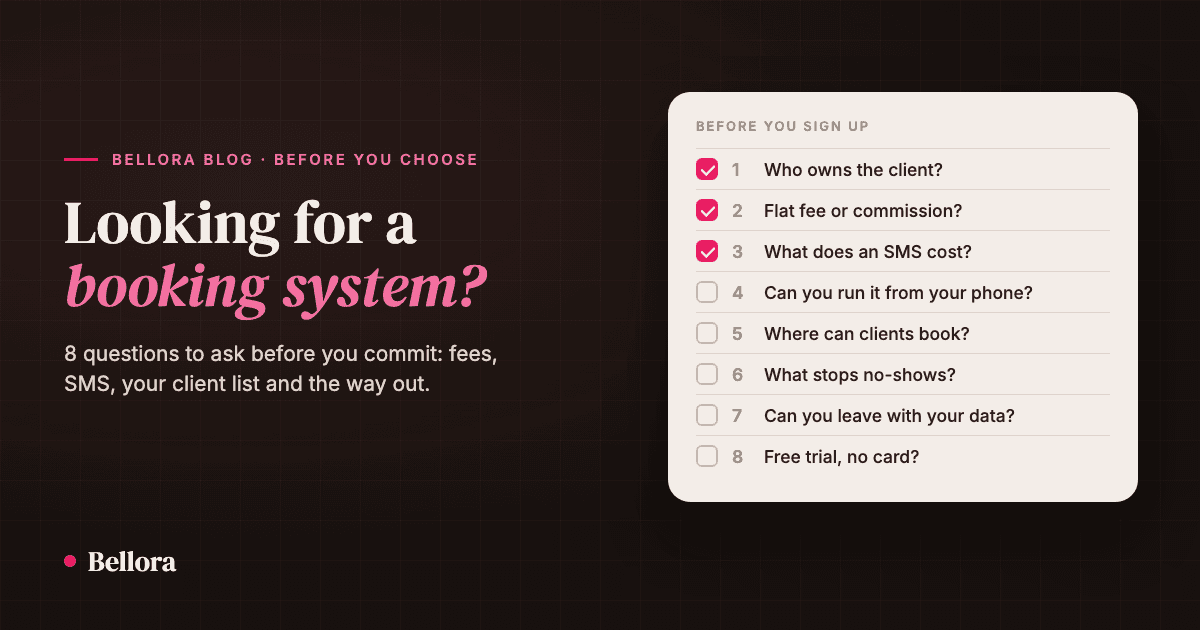
The right booking system isn't the one with the longest feature list. It's the one that still holds no surprises six months in. 8 questions worth asking before you choose any of them.
By
This website uses cookies for a better user experience. Cookie Policy

There's one sentence we hear from salon owners over and over, and the same fear always hides behind it:
"I know I should raise my prices, but I'm afraid my clients will leave."
Sound familiar? If so, you're in the right place. Because the truth is that most salons aren't too expensive — they're too cheap, and they go years without touching their prices. Meanwhile products cost more, utilities climb, wages have to be paid, and you work harder and harder for less and less. Your calendar is full, yet there's barely anything left at the end of the month.
This article is about breaking out of that. Not raising prices on a hunch, but deliberately: working out what an hour in your chair actually costs, recognising when the moment has come, deciding how much to raise, and communicating it so that most of your clients nod and stay.
Before we get to the numbers, it's worth understanding where the hesitation comes from. Because the problem isn't the arithmetic — it's the brake in our own heads.
The most common reason is fear of losing the client. It feels like every increase is one more reason for someone to defect to the salon down the road. In practice this happens far less often than you'd think — more on that shortly.
The second is guilt. Many professionals experience their work as a personal favour, and find it uncomfortable to ask for money. "She's known me for years, how could I charge her more?" But a salon isn't a hobby, it's a living — and your long-time client knows that too.
The third is a bad reference point. You anchor to the price list of the salon next door instead of starting from your own costs. Except you have no idea whether they're profitable or also fighting to survive. You might be matching your prices to a sinking ship.
The common thread in all three: you're trying to set your price from the outside — from the client's reaction, your feelings, the competition. But the first half of a price comes from the inside: from your own costs.
Question: what does a single hour in your chair cost you? Not what you charge for it — what it costs.
Most salon owners get stuck here, even though it's the cornerstone of the whole thing. Without it you're firing blind. With it, you have a floor you never drop below.
You don't need an accounting degree — one quiet evening and a sheet of paper will do. For a full month, write down:
Add up your fixed costs and the pay you want for yourself, divide by the number of hours you actually spend in the chair in a month (not your opening hours — your real, treatment-filled hours), and add the product cost of the specific treatment. That's your cost for one hour. Your price has to sit above it — noticeably above, because what you earn on top of it is your buffer, your growth, your time off.
The first time a salon owner does this, an uncomfortable realisation often lands: a few of their "popular" services barely break even, or actually lose money. That's not a failure — it's the moment you finally see where the money is leaking.
There's no magic date, but there are a few clear signals. If several of these are true for you, you're probably already overdue:
The full calendar is the most important of these. Many owners think the opposite: "I'll raise once I have more clients." But if you're already full, raising doesn't scare clients away — it makes room: the few price-sensitive clients who drift off are replaced by the ones who happily pay for quality.
The most common mistake here is going years without touching the price, then panicking and jumping it all at once — and it's precisely that big jump that alarms clients.
A small but regular increase works far better. Most clients take a modest annual adjustment as natural — they can see everything is getting more expensive too. A rare, large jump shocks them, because it puts the old and new price side by side.
A few practical pointers:
The goal isn't a perfect number on the first try — it's to get started, so that from then on the annual adjustment becomes an obvious routine, not a dreaded, postponed decision.
This is where most people stumble — and it's where everything is decided. It isn't the increase that scares the client off, it's bad communication: the sudden confrontation at the till, the apologetic mumbling, the new price hidden in an unspoken envelope.
A few principles that work:
Give notice — don't spring it at the till. The worst thing you can do is let the client find out when they pay. Give a few weeks' warning — by email, SMS, or even in the booking confirmation. Someone who knows in advance prepares; someone you surprise takes offence.
Be direct, don't apologise. You don't need to apologise for making a living from your work. One calm, matter-of-fact sentence beats any amount of explaining. Over-apologising signals that you don't feel it's justified either — and the client picks that up.
Tie it to value, not just to utility bills. "Everything got more expensive" is true, but tiring. It's stronger to point to the quality behind it: your training, better products, the calm, comfortable experience they get with you.
A well-written advance notice looks roughly like this:
Hi Anna! Just letting you know that from [date] my prices are being updated, so I can keep welcoming you with the same quality and in the same relaxed setting. The new price for a haircut will be [amount]. Thank you for coming to me — I'm glad I can keep counting on you! Warmly, [Your name]
Short, warm, direct. No apology, but a date and a concrete price — and a personal touch at the end. Someone who receives this doesn't experience it as an attack, but as fair notice given in advance.
Raising prices isn't the only way to keep more in the register. Sometimes you don't even need to touch the list price.
Add-on services. Care alongside a haircut, gel alongside a manicure, a premium product alongside a treatment. The client is already in the chair — a well-timed, natural suggestion raises the average ticket without scaring anyone off.
Packages and passes. Several sessions bundled together at a slightly better unit price. For you it brings predictable, foreseeable revenue and keeps the client; for them it delivers tangible value. Win-win.
Deposits on expensive, long treatments. Strictly speaking this isn't pricing, but it protects your revenue directly: a deposit taken up front dramatically reduces the losses from no-shows. An afternoon left empty is the fastest way to melt away the margin you just earned by raising prices. (We wrote about this separately: How to reduce no-shows at your salon.)
This mindset is liberating: you don't have to charge everyone more for everything. It's enough for the average client to leave a little more value with you on average — and there are many ways to get there.
Let's be honest: some will grumble, and one or two price-sensitive clients may move on. That's not a failure — it's a natural part of pricing.
Think about who leaves first when you make a modest increase. Almost always it's the one who spent the least, haggled the most, and cancelled the soonest. The client who chooses purely on price will never be loyal — they'll move on at the next discount anyway. When their spot opens up, it's filled by the new client who happily pays for quality and returns for years.
For a fully booked salon, this isn't a loss — it's a trade up. And the more you're the person chosen not for the price list but for the work, the atmosphere, the reliability, the less a price-sensitive client's goodbye stings. A good salon description and strong online presence builds exactly that: it brings clients who aren't looking for the cheapest, but for you.
The strategy is yours — but we make the execution easier. In Bellora:
But the point isn't the software, it's the decision: that your prices finally serve your work and your livelihood, not the fear.
Pricing isn't against the client — it's for them and for you. Work out what an hour costs you, recognise the signals (full calendar, rising product costs, prices that haven't moved in a year), raise a little and regularly rather than rarely and steeply, and give notice — directly, without apology. Whoever leaves over it probably wouldn't have stayed long anyway — whoever stays values you.
The hardest part is the first step. If you've been putting it off, this week is a good time to sit down one evening with the numbers — and finally build a price list that actually sustains you.
Updated: 17 July 2026.


The right booking system isn't the one with the longest feature list. It's the one that still holds no surprises six months in. 8 questions worth asking before you choose any of them.
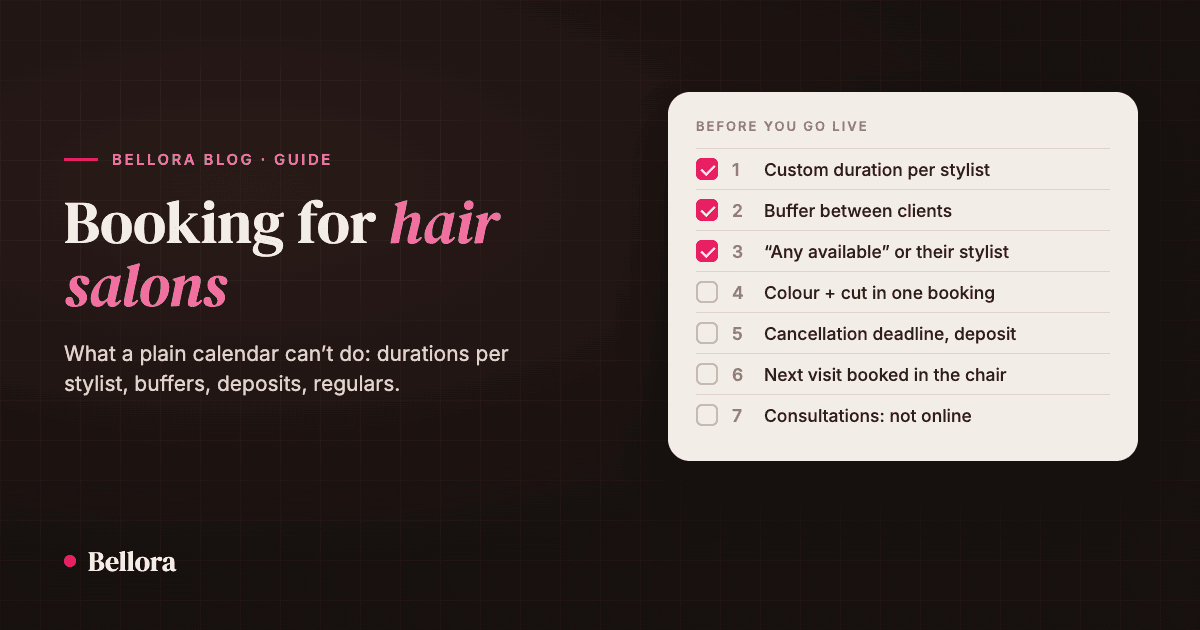
A hair salon day isn't made of identical 30-minute blocks. Here's what a booking system needs to handle, from colour appointments to regulars – and where its limits are.
Yoga classes, workshops, courses: a group class is a different game from a one-on-one appointment. How to set capacity wisely, what to do when a class fills up, and how the waitlist hands a freed spot to the next in line automatically.