Guides
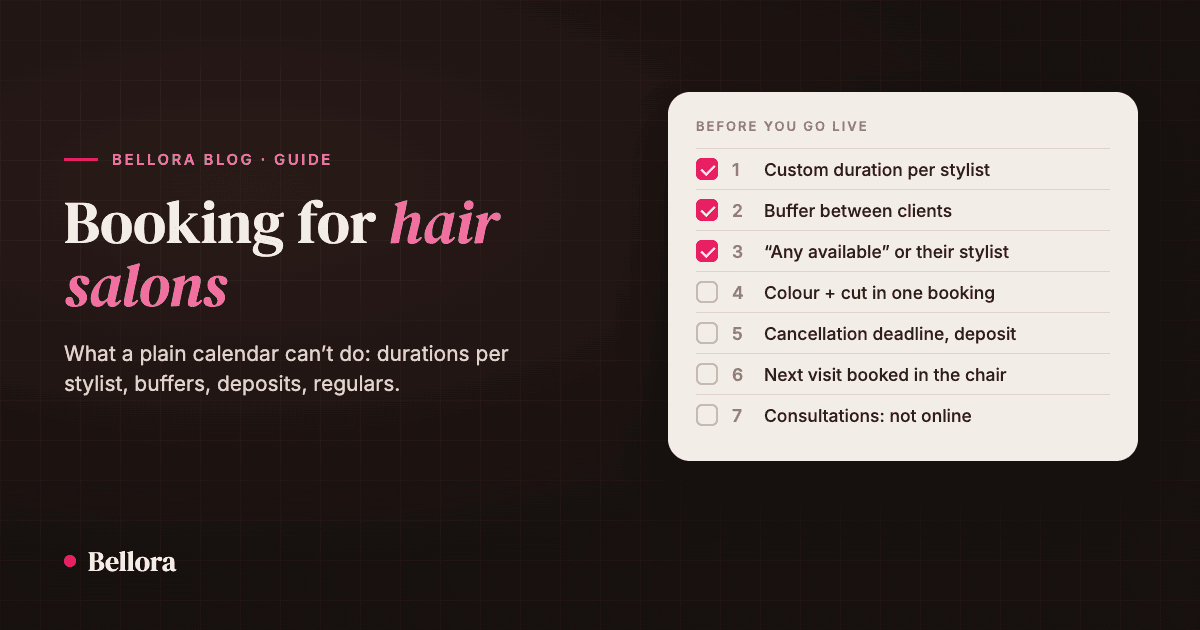
A hair salon day isn't made of identical 30-minute blocks. Here's what a booking system needs to handle, from colour appointments to regulars – and where its limits are.
By
This website uses cookies for a better user experience. Cookie Policy

Tuesday, 6 pm, yoga class, eight spots. On Monday a ninth person messages you: "Hi! Any space left for tomorrow?" There isn't. You jot their name down, promising to reach out if someone cancels. On Tuesday at noon someone actually does cancel — but you're mid-class, the note is in your bag, and by the time you reply in the evening, that ninth person has made other plans. The class runs with seven people, even though nine wanted to come.
That scene is the real pain of group classes. Publishing the schedule isn't the hard part, and neither is collecting sign-ups — it's managing the traffic after a class fills up. And that's exactly the part that's nearly impossible to do well by hand, in messages.
Let's walk through the whole thing from the start: what makes a group class different from a regular appointment, what to watch when you set one up, and how freed-up spots can find a new owner on their own.
With a one-on-one appointment the formula is simple: one client, one chair, one time slot. A group class — yoga, spine training, a workshop, a course session — attaches many independent clients to a single time slot. Three things follow from that:
If you've been running this in a spreadsheet, in comments or in DMs, you know exactly where it falls apart: somewhere between the cancellations and the "I'll let you know if a spot opens up" promises.
Before we get to the waitlist, three settings decide whether your classes work well.
Let reality set the capacity, not optimism. Offer as many spots as the class can hold while still being good — based on the room, the equipment and your own attention. Better to have a smaller class fill up regularly (and build a waitlist) than an oversized one running half-empty.
Price per session. With group classes, clients typically pay for the specific session. If your class is paid and you collect payment online, a spot is only taken together with the payment — which also means the sign-up is serious: someone who has paid shows up. (It's the same logic that makes deposits reduce no-shows for individual appointments — we've written a separate article about that.)
Make the schedule predictable. A fixed weekly slot — Tuesday 6 pm, Thursday 9 am — isn't just convenient for you: it's how your clients build a routine. Ideally your system rolls the weekly repetition forward on its own, so you're not manually entering next week's sessions every Sunday.
And here's the heart of it. When a class fills up, there are two roads.
The manual road: the person who missed out gets a promise ("I'll let you know if a spot opens"), and you get an extra task with an unknown deadline. When a cancellation comes in, you have to notice it, dig out who asked first, write to them, wait for a reply — and if they don't answer, start over with the next person. It's exactly the kind of work that's still buzzing in your head at 10 pm.
The other road is letting a system do all of it for you:
Meanwhile, on the class page you can see who's waiting, in what order, and who currently has an offer out — and if you want, you can offer a spot to someone manually, or remove someone who has changed their mind.
Our take: the waitlist is not a nice-to-have. On a full class it's the difference between a cancellation being lost revenue or another client. And just as important: the person who missed out doesn't hold a forgotten promise — they hold a working place in line.
The client's side is deliberately boring — that's the point. They book on the same booking link or page where they'd book an individual appointment: they pick the class, see the number of free spots, and book. On a full class, one button puts them on the waitlist. When a spot frees up, they get an email, confirm with one click — done.
No separate app, no registration marathon, no "DM me". It's the same principle that makes a 24/7 bookable link bring in new clients: the less friction, the more people make it all the way to an actual sign-up. Guests who prefer an app can do the same in the free Bellora app (App Store · Google Play), but nobody has to install it.
In practice the whole thing takes a few minutes:
One last piece of advice: launch your first session with communication, not just settings. Message your regulars, put the booking link in your Instagram bio, and mention it in person at the salon — group classes are now bookable online, no queueing, no message threads. The waitlist shows its power the moment your first class fills up. And if you do this right, that moment comes sooner than you'd think.
Group classes are part of Bellora — if you're not using it yet, you can try it for free and publish your first class today.
Updated: 10 July 2026.


A hair salon day isn't made of identical 30-minute blocks. Here's what a booking system needs to handle, from colour appointments to regulars – and where its limits are.
What is this blog, who is it for, and where should you start? A short intro plus our best articles in one place: bookings, no-shows, winning new clients.
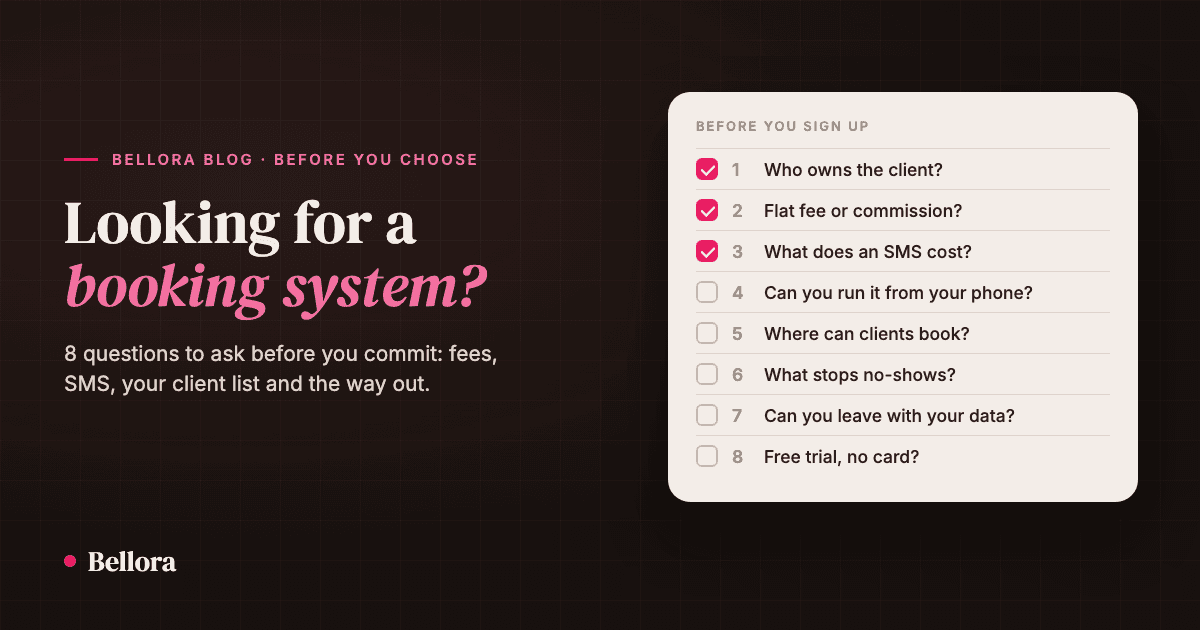
The right booking system isn't the one with the longest feature list. It's the one that still holds no surprises six months in. 8 questions worth asking before you choose any of them.